


Premier Analytics Consulting at the Southeast and Atlantic SAS® Users Group (SEASUG) 2026 Conference
Professional training, papers, and presentations delivered at the SEASUG 2026 Conference in Malvern, Pennsylvania.
SEASUG 2026 Conference, held in the Greater Philadelphia area in Malvern, Pennsylvania, will include technical training, published papers, and conference presentations by Premier Analytics Consulting, LLC. Our CEO and Lead Consultant, Ryan Paul Lafler, will deliver the training workshop Mastering AI Systems and Machine Learning with Python: Training, Tuning, and Interpreting Predictive Models, focused on practical methods for building, evaluating, tuning, and interpreting machine learning workflows using Python's scikit-learn framework.
Premier Analytics Consulting's contributions at SEASUG 2026 reflect our broader work across applied AI, machine learning, statistical analysis, and modern open-source analytical systems. In addition to the training workshop, our conference participation includes papers and technical presentations that emphasize practical implementation, reproducible workflows, and technically rigorous approaches for real-world analytical and decision-support environments.
Hands-On Training Workshop
Training developed and delivered by the Premier Analytics Consulting team.
Mastering AI Systems and Machine Learning with Python: Training, Tuning, and Interpreting Predictive Models
Ryan Paul Lafler
Date: October 22, 2026
Time: 1:00 PM - 4:30 PM ET
Location: Malvern, Pennsylvania (Greater Philadelphia)
Training Workshop Description
This hands-on workshop provides a practical introduction to building machine learning workflows that support modern AI systems using Python. Designed for data scientists, statisticians, programmers, machine learning engineers, researchers, analysts, and students, this workshop focuses on how to prepare data, train supervised learning models, tune model performance, and interpret predictive results for classification and regression tasks. Attendees will gain practical experience with Python’s open-source machine learning ecosystem, with an emphasis on organized, reproducible machine learning pipelines, model evaluation and selection, and fine-tuning strategies. Through guided examples and hands-on exercises, attendees will learn how machine learning models are developed as part of broader AI systems and how predictive models can be trained, evaluated, and interpreted within reliable analytical workflows. Emphasizing a model-driven approach, this workshop incorporates data preparation for machine learning pipelines, balancing model complexity with interpretability, and addressing common modeling challenges such as overfitting, underfitting, feature selection, and generalization to unseen data. Attendees will work within the scikit-learn ecosystem to build structured workflows for analytical and machine learning problems. Key topics covered in this workshop include: ➤ Data cleaning and exploratory data analysis (EDA) to uncover feature relationships Building comprehensive scikit-learn pipelines to clean data, engineer features, and prepare datasets for machine learning ➤ Training and interpreting supervised learning models, including LASSO regularization, decision trees, random forests, and gradient-boosted ensembles ➤ Hyperparameter tuning, search spaces, feature selection, and strategies for improving generalization to unseen data ➤ Model evaluation strategies, data partitioning techniques, and evaluation metrics for classification and regression ➤ Understanding the bias-variance tradeoff and model interpretability ➤ Connecting machine learning workflows to broader AI system design and applied analytics and decision-making This workshop helps attendees move beyond treating machine learning as a “black box” and instead develop a practical understanding of how predictive models are trained, tuned, evaluated, and interpreted in modern AI workflows. By the end of this workshop, participants will have built structured Python-based machine learning pipelines that can support reproducible analysis, predictive modeling, and applied AI system development. All registered attendees will receive non-redistributable PDF slides, fully documented Python notebooks, and workshop datasets so they can reproduce the analyses and continue practicing the methods after the tutorial session.
Published Technical Papers
Technical papers authored and published by the Premier Analytics Consulting team.
Building Better Data Science Workflows: Best Practices with Git, GitHub, Data Version Control (DVC), and MLflow for Open-Source Collaboration
Ryan Paul Lafler
Abstract
This paper presents a practical framework for building reliable, reproducible, and collaborative data science workflows using Git, GitHub, Data Version Control (DVC), and MLflow. It begins by introducing Git as the foundation for tracking code changes and GitHub as a collaboration layer for shared repositories, branching strategies, pull requests, and team-based development. DVC is then presented as an extension to version control that enables datasets, intermediate outputs, and analytical artifacts to be tracked, compared, and restored alongside code without storing large files directly in Git repositories. The paper demonstrates strategies and techniques for meaningful commit practices, managing work-in-progress (WIP) safely, reducing merge conflicts, and maintaining structured project histories across collaborative environments. Building on this foundation, MLflow is introduced as a lightweight experiment tracking and model management layer for machine learning workflows in Python, allowing teams to record training runs, fine-tuning parameters, evaluation metrics, model artifacts, and performance comparisons during iterative development. Together, Git, GitHub, DVC, and MLflow provide an integrated open-source ecosystem for managing code repositories, versioning data, and tracking model experiments across collaborative data science, machine learning, and analytics projects.
Keywords: Git; GitHub; Data Version Control (DVC); MLflow; Reproducible Research; Data Science Workflows; Machine Learning Workflows; MLOps; Data Engineering; Experiment Tracking; Clinical Trials; Reproducible Analytics
Section: Data Collection, Management, & Manipulation
Charting Your Organization's AI Roadmap: A Practical Approach from Machine Learning Foundations to Generative and Agentic AI
Ryan Paul Lafler
Abstract
Artificial Intelligence (AI) continues to reshape business, technology, science, and research by enabling systems to learn from data, automate workflows, and support more adaptive decision-making. This paper presents a practical roadmap for understanding AI through the progression from machine learning (ML) foundations to modern generative and agentic AI systems. It introduces AI as a broad field and machine learning as a data-driven approach to AI, then examines supervised learning for predictive analytics on labeled data, unsupervised learning for pattern discovery in unlabeled data, and generative learning for representation learning, synthesis, reasoning, and content generation. The paper introduces key algorithms, architectures, use cases, model hyperparameters, and practical considerations such as overfitting, underfitting, and model evaluation to support applied implementation across industry settings. It concludes by connecting deep learning with modern generative model architectures, including encoder models, decoder-only large language models, and encoder-decoder models, to the emerging shift toward agentic AI systems that combine models with retrieval, tools, APIs, and workflow orchestration to support practical industry use cases in 2026, 2027, and beyond.
Keywords: Enterprise AI; Supervised ML; Unsupervised ML; Generative AI; Agentic AI; Open-Source AI; Deep Learning; Neural Networks; Transformer Architectures; AI Integration; Predictive Analytics; Data Mining
Section: AI & Emerging Technologies
A Practical Roadmap for the 2026 Enterprise Generative AI Stack: AI Agent Architectures, Frameworks, and Secure Deployment
Ryan Paul Lafler
Abstract
Generative AI is rapidly reshaping how organizations search, reason over, and contextualize information, yet deploying these systems on private, confidential, and sensitive data introduces distinct architectural, performance, and governance challenges. This paper presents a practical roadmap for the 2026 and 2027 enterprise generative AI stack, with emphasis on agentic AI architectures built on retrieval-augmented generation (RAG), vector embeddings, and secure model deployment. Core concepts including encoding, similarity search, and vector databases are introduced to explain how knowledge is stored, retrieved, and reused across AI agents, alongside API-driven patterns that enable tools for search, reasoning, and contextualization. The discussion contrasts proprietary large language models (LLMs) and open-source small language models (SLMs), highlighting trade-offs in output quality, performance, and deployment, while examining how ecosystems such as Hugging Face support localized inference and domain-specific adaptation. Implementation considerations are presented primarily in Python, with extensions to R and SAS® Viya®, focusing on secure, reproducible analytics workflows. This paper concludes with prompt engineering strategies and ethical considerations for responsible generative AI use on sensitive enterprise data in the life sciences, pharmaceutical, and healthcare domains.
Keywords: Generative AI; Agentic AI; Retrieval-Augmented Generation (RAG); Tool-Calling Agent; Multi-Step Planning Agent; Vector Embeddings; Vector Database; Large Language Models (LLMs); Small Language Models (SLMs); Enterprise AI; Open-Source AI; Hugging Face; Clinical AI; R&D AI
Section: AI and Emerging Technologies
Enhancing Your SAS® Viya® Workflows with Python: Integrating Python's Open-Source Libraries with SAS using PROC PYTHON
Ryan Paul Lafler; Miguel Angel Bravo
Abstract
Developers, data scientists, and analysts are increasingly leveraging open-source tools and libraries to integrate with and enhance their existing data engineering and analytical workflows. One of these integrations, built into SAS® Viya®, is its pre-configured Python runtime integration, PROC PYTHON, that gives SAS programmers access to Python's open-source data science libraries for processing, visualizing, and analyzing data alongside SAS procedures. This presentation demonstrates how to access and use Python libraries in Viya runtimes; understand data-handling in Python and SAS; build Python scripts with reusable methods that import, process, and analyze data; and execute those Python methods to export Pandas DataFrames as SAS datasets.
Keywords: SAS® Viya®; PROC PYTHON; SAS-Python Integration; Open-Source Integration; Hybrid Analytics Workflows; Data Engineering; Pandas Library; SAS Dataset; Software Interoperability
Section: Intermediate & Advanced Coding
SEASUG 2026 Conference Highlights
See the Premier Analytics Consulting team in action.
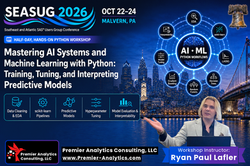 Mastering AI Systems and Machine Learning with Python: Training, Tuning, and Interpreting PredictiveTraining workshop on building AI workflows in Python for predictive analytics. Taught by Ryan Paul Lafler at the SEASUG 2026 Conference on October 22, 2026. |
|---|

Connect with Premier Analytics Consulting
Expert services and solutions in AI, data engineering, full-stack systems, advanced statistical analysis, enterprise GIS, and open-source modernization.
Premier Analytics Consulting helps organizations deliver secure, modern, and data-driven solutions across AI, data engineering, full-stack architectures, advanced statistical analysis and reporting, enterprise GIS, environmental informatics, and open-source modernization. We welcome opportunities for contracting, subcontracting, technical partnerships, advisory support, training, and project-based assignments, and support clients with specialized implementation, analytical workflows, solution architecture, and modern data system development across business, enterprise, research, and public-sector environments.