


Premier Analytics Consulting at the Pharmaceutical Software User Group (PharmaSUG) 2026 U.S. Conference
Professional training, papers, and technical presentations delivered at the PharmaSUG 2026 Conference in Boston, Massachusetts.
PharmaSUG 2026, held in Boston from May 31 through June 3, 2026, was a pharmaceutical and life sciences conference attended by Premier Analytics Consulting, LLC. Ryan Paul Lafler, our CEO and Lead Consultant, participated through professional training, technical presentations, published papers, and networking with organizations across the clinical, life sciences, bioinformatics, and statistical consulting sectors.
Ryan delivered a pre-conference training seminar on statistical analysis and hypothesis testing using R, SAS®, and Python, with practical emphasis on clinical, pharmaceutical, and regulatory submission workflows. This hands-on training seminar was gave attendees an applied, cross-language foundation for rigorous analytical work in regulated environments.
During the conference, Ryan presented and published multiple papers spanning enterprise AI, open-source innovation, SAS® and Python integration, and modern collaborative data science workflows. A major conference highlight was receiving the Best Paper Award in the Emerging Technologies section for ET-207, recognizing our team's applied work on extending SAS® Viya® workflows with Python’s open-source ecosystem through PROC PYTHON.
Hands-On Training Workshop
Training developed and delivered by the Premier Analytics Consulting team.
Mastering Statistical Hypothesis Testing: Comparative Statistical Programming, Analysis, and Modeling for Python, R, and SAS®
Ryan Paul Lafler
Date: May 31, 2026
Time: 8:00 AM - 12:00 PM ET
Location: Boston, Massachusetts
Training Workshop Description
This hands-on training seminar delivers a clear, comparative, and applied foundation in statistical hypothesis testing and modeling across the R, Python, and SAS® programming languages. Designed for analysts, data scientists, researchers, and professionals in clinical, healthcare, pharmaceutical, and other data-driven industries, the workshop emphasizes practical programming applications for model selection, checking assumptions, running diagnostics, and interpreting results. Registered attendees will learn when to apply parametric vs. non-parametric tests, how to distinguish statistical significance from practical or clinical significance, and how to conduct power analyses to determine the minimum sample size needed for effective study design. Through guided exercises, participants will perform exploratory data analysis (EDA), describe and visualize datasets, build statistical models, and interpret results using: ▪️R (RStudio by Posit) ▪️Python (Jupyter Notebook) ▪️SAS® 9.4 (free-to-use SAS® OnDemand for Academics) This training seminar is structured to highlight cross-language similarities and differences, giving attendees a practical roadmap for statistical analysis using Python, R, or SAS® 9.4. Key topics include: ▪️Understanding statistical significance, effect size, and practical significance in experiments ▪️Exploratory data analysis (EDA), summarization, and visualization across R, Python, and SAS® ▪️Comparing two groups: 2-sample t-test (Welch’s) and Mann-Whitney U test ▪️Comparing multiple groups: One-way ANOVA models and Kruskal-Wallis test ▪️Modeling factorial ANOVA and evaluating interaction effects ▪️Checking model assumptions and conducting diagnostic tests for reliability ▪️Statistical power, sample size determination, and study design considerations All registered attendees will receive the non-redistributable PDF slides, fully documented R, Python, and SAS® code examples, and the complete workshop dataset to continue practicing and enhancing their skills after the seminar.
Published Technical Papers
Technical papers authored and published by the Premier Analytics Consulting team.
ET-207 | Enhancing Your SAS® Viya® Workflows with Python: Integrating Python’s Open-Source Libraries with SAS® using PROC PYTHON (*BEST PAPER)
Ryan Paul Lafler; Miguel Angel Bravo
Abstract
Data scientists, statistical programmers, machine learning engineers, and researchers are increasingly leveraging a growing number of open-source tools, libraries, and programming languages that can enhance and seamlessly integrate with their existing data workflows. One of these integrations, built into SAS® Viya®, is its pre-configured Python runtime integration, PROC PYTHON, that gives SAS programmers access to Python's open-source data science libraries for wrangling and modeling structured and unstructured data alongside the validated procedures provided in SAS. This paper demonstrates how to install and import external Python libraries into their SAS Viya sessions; generate Python scripts containing methods that can import, process, visualize, and analyze data; and execute those Python methods and scripts using SAS Viya's PYTHON procedure. By integrating the added functionalities of Python's libraries for data processing and modeling with SAS procedures, SAS programmers can enhance their existing data workflows with Python's open-source data solutions.
Tags: SAS® Viya®, PROC PYTHON, Python Integration, SAS-Python Integration Architecture, Pandas, Hybrid Analytics Workflows, Open-Source Integration, Data Engineering Workflows, Reproducible Analytics, Regulated Industries, Enterprise Analytics
Section: Emerging Technologies
AI-316 | A Practical Roadmap for the 2026 Enterprise Generative AI Stack: AI Agent Architectures, Frameworks, and Secure Deployment
Ryan Paul Lafler
Abstract
Generative AI is rapidly reshaping how organizations search, reason over, and contextualize information, yet deploying these systems on private, confidential, and sensitive data introduces distinct architectural, performance, and governance challenges. This paper presents a practical roadmap for the 2026 enterprise generative AI stack, with emphasis on agentic AI architectures built on retrieval-augmented generation (RAG), vector embeddings, and secure model deployment. Core concepts including encoding, similarity search, and vector databases are introduced to explain how knowledge is stored, retrieved, and reused across AI agents, alongside API-driven patterns that enable tools for search, reasoning, and contextualization. The discussion contrasts proprietary large language models (LLMs) and open-source small language models (SLMs), highlighting trade-offs in output quality, performance, and deployment, while examining how ecosystems such as Hugging Face support localized inference and domain-specific adaptation. Implementation considerations are presented primarily in Python, with extensions to R and SAS® Viya®, focusing on secure, reproducible analytics workflows. This paper concludes with prompt engineering strategies and ethical considerations for responsible generative AI use on sensitive enterprise data in the life sciences, pharmaceutical, and healthcare domains.
Tags: Generative AI, Agentic AI, AI Agents, Retrieval-Augmented Generation (RAG), Tool-Calling Agents, Multi-Step Planning Agents, Vector Embeddings, Vector Databases, Large Language Models (LLMs), Small Language Models (SLMs), Enterprise AI, Open-Source AI, Secure AI, Hugging Face, Python, R, SAS® Viya®, Clinical AI, Healthcare AI, Pharmaceutical AI, R&D AI
Section: AI in Pharma, Biotech and Clinical Data Science
ET-327 | Building Better Data Science Workflows: Best Practices with Git, GitHub, and Data Version Control (DVC) for Effective Collaboration
Ryan Paul Lafler
Abstract
This paper presents a practical framework for building reliable and collaborative data science workflows using Git, GitHub, and Data Version Control (DVC). It begins by explaining the importance of version control in data science and introduces Git as the foundation for tracking code changes. GitHub is then presented as a collaboration layer for shared repositories and team-based development. DVC is introduced as an extension to version control that enables efficient tracking and versioning of datasets alongside code. The paper presents practical examples demonstrating structured branching strategies, meaningful commit practices, managing work-in-progress (WIP) safely, and reducing merge conflicts in team environments. DVC workflows are demonstrated to show how dataset changes can be tracked, compared, and restored without storing large files directly in Git repositories. Together, these tools provide a structured and reproducible workflow for collaborative data science, machine learning, and analytics projects. The paper concludes with industry applications in regulated environments where reproducibility, auditability, and collaboration are essential.
Tags: Git, GitHub, Data Version Control (DVC), MLflow, Reproducible Research, Data Science Workflows, Machine Learning Workflows, Collaboration, MLOps, Data Engineering, Experiment Tracking, Clinical Trials, Pharmaceutical Research, Reproducible Analytics
Section: Emerging Technologies
ET-205 | The Open Source Advantage: Powering Innovation in the 21st Century
Kirk Paul Lafler; Ryan Paul Lafler; Joshua Cook; Stephen Sloane; Anna Wade
Abstract
Organizations worldwide are undergoing a fundamental shift in how software is developed, deployed, and sustained. The rapid emergence of new technologies, combined with the accelerating adoption of open-source solutions – has created an ecosystem where innovation thrives alongside increased complexity. As diverse tools, platforms, and communities converge, organizations must balance opportunity with risk. This presentation examines the benefits, challenges, and emerging opportunities of open-source technologies in the 21st century. Participants will explore how organizations and user communities are addressing critical considerations, including system integration and compatibility, security vulnerabilities, intellectual property concerns, licensing and warranties, and the variability of development and support practices. Attendees will gain practical insight into the evolving roles of Python, R, SQL, modern database platforms, cloud computing, and open software standards, as well as the collaborative culture that fuels global open-source innovation. Join us for a forward-looking discussion on how open-source software is reshaping technology strategy, collaboration models, and innovation across industries.
Tags: Open-Source Modernization, Python, R, Linux, Apache, GDAL, PostgreSQL, Anaconda
Section: Emerging Technologies
PharmaSUG U.S. 2026 Conference Highlights
See the Premier Analytics Consulting team in action
 Presenting the 2026 Enterprise Generative AI StackRyan Paul Lafler presenting AI-316: A Practical Roadmap for the 2026 Enterprise Generative AI Stack: AI Agent Architectures, Frameworks, and Secure Deployment, focused on practical enterprise AI architecture, orchestration frameworks, and secure deployment strategies. |  Sharing Applied Insights at PharmaSUGConference presentations by Ryan Paul Lafler focused on practical topics spanning enterprise AI, open-source innovation, SAS® and Python integration, and modern collaborative data science workflows for technical and regulated environments. |
|---|---|
 Connecting with the PharmaSUG CommunityPharmaSUG 2026 provided valuable opportunities to network with professionals across bioinformatics, life sciences, consulting, clinical research, and statistical programming. |  Best Paper Recognition in Emerging TechnologiesRyan Paul Lafler received the Best Paper Award in the Emerging Technologies section for ET-207: Enhancing Your SAS® Viya® Workflows with Python: Integrating Python’s Open-Source Libraries with SAS® using PROC PYTHON. |
 Best Paper Award – Emerging TechnologiesFormal recognition of Ryan Paul Lafler's Best Paper Award at PharmaSUG 2026 for applied work demonstrating how Python’s open-source ecosystem can extend and strengthen SAS® Viya® workflows through PROC PYTHON. |  Pre-Conference Training SeminarRyan Paul Lafler delivered a pre-conference training seminar on statistical hypothesis testing, comparative programming, and applied analysis in R, SAS®, and Python, with emphasis on clinical, pharmaceutical, and regulatory submission contexts. |
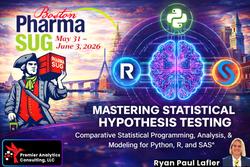 Mastering Statistical Hypothesis TestingThe seminar provided a practical, cross-language roadmap for statistical analysis and modeling in Python, R, and SAS®, covering hypothesis testing, diagnostics, interpretation, and applied workflows relevant to clinical and regulatory environments. |

Connect with Premier Analytics Consulting
Expert services and solutions in AI, data engineering, full-stack systems, advanced statistical analysis, enterprise GIS, and open-source modernization.
Premier Analytics Consulting helps organizations deliver secure, modern, and data-driven solutions across AI, data engineering, full-stack architectures, advanced statistical analysis and reporting, enterprise GIS, and open-source modernization. We welcome opportunities for contracting, subcontracting, technical partnerships, advisory support, training, and project-based assignments, and support clients with specialized implementation, analytical workflows, solution architecture, and modern data system development across business, enterprise, research, and public-sector environments.